
Knowledge

Food Safety × Manufacturing × Freezing Technology | Gain deeper insights into professional food knowledge with Sugar Lion.
The Knowledge Center provides practical articles on frozen food manufacturing, food safety standards, ingredient selection, frozen storage, and processing technologies, helping customers, distributors, and consumers understand food production and safety standards from a professional perspective.
The Knowledge Center provides practical articles on frozen food manufacturing, food safety standards, ingredient selection, frozen storage, and processing technologies, helping customers, distributors, and consumers understand food production and safety standards from a professional perspective.
Q & A
1.Food Safety Management
Personal Hygiene
Maintain personal cleanliness at all times to prevent food contamination.
Hair
Wear a hairnet at all times during production. Long hair must be securely tied and fully covered to prevent contamination.
Fingernails
Keep fingernails short and clean, as long nails can easily trap dirt and bacteria.
Hands
Wash hands thoroughly before and after handling food, after disposing of waste, after using the restroom, and whenever contamination may occur. Handwashing should last at least 30 seconds.
Wounds
All cuts and wounds must be properly covered before entering production areas to reduce the risk of bacterial contamination and ensure food safety.

Facility Hygiene
Equipment and utensils are cleaned and sanitized according to their risk classification.
Risk Level
Contact Type
Cleaning Frequency
Examples
High Risk
Direct Food-Contact Items
Clean and sanitize immediately after each use.
Knives, cutting boards, dishes, and food-contact utensils
Medium Risk
Indirect Food-Contact Items
Clean once daily or every 2–3 days, depending on usage.
Aprons, carts, trolleys
Low Risk
Non-Food-Contact Equipment
Clean once a week or every two weeks.
Delivery carts, kitchen walls, non-food-contact facilities
Facility Hygiene
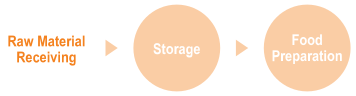
Supplier Approval
Raw material suppliers are evaluated and approved in accordance with food safety standards and supplier qualification requirements.
Incoming Material Inspection
Every batch of raw materials is inspected upon arrival, including appearance, odor, temperature, and water activity.
Lot Number & Traceability
Each batch is assigned a unique Lot Number (Lot No.) and recorded within a complete traceability system.
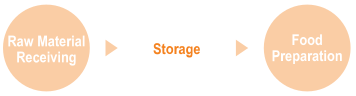
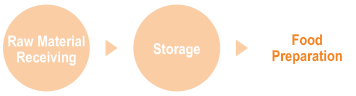
Receiving & Cold Storage
Surimi, chicken, pork, and beef products are inspected under temperature-controlled conditions before being accepted into cold storage.
區域名稱
乾料庫
冷藏庫
冷凍庫
儲存食材
乾燥的食材、飲品或調味料
例如:香菇、辣椒
例如:香菇、辣椒
易變質的食材
例如:雞蛋、蔬菜、冷凍食品、速食食品
例如:雞蛋、蔬菜、冷凍食品、速食食品
冷凍食品、速食食品
例:肉品、海鮮
例:肉品、海鮮
儲存溫度
18度以下
-5 ~ 5度之間
零下18度以下
Thawing Procedures
To ensure food safety and maintain product quality, frozen products should be transferred from the freezer to refrigerated storage for controlled thawing.
When time is limited, products may be thawed under cold running water as an alternative. Throughout the thawing process, the original packaging must remain sealed to prevent contamination and ensure food safety.
When time is limited, products may be thawed under cold running water as an alternative. Throughout the thawing process, the original packaging must remain sealed to prevent contamination and ensure food safety.
2.What Is Non-Treated Shrimp?

What Does "Non-Treated" Mean?
Authentic non-treated shrimp refers to shrimp that has not been treated with STPP (Sodium Tripolyphosphate) or any other chemical water-retention agents throughout the entire process—from harvesting and peeling to freezing.
Supplier Approval
We source shrimp only from qualified suppliers that comply with strict food safety standards and quality assurance requirements.
True Net Weight
Our shrimp contains only the natural protein and moisture found in the shrimp itself—without artificially retained water or chemical additives.

Nutritional Value & Health Benefits
Naturally non-treated shrimp provides high-quality nutrition without added phosphate treatments, making it an excellent choice for health-conscious consumers and those seeking a cleaner, more natural seafood option.
Low Phosphate Burden
Unlike phosphate-treated shrimp, our non-treated shrimp contains no added phosphates (STPP). It retains only the naturally occurring phosphorus found in shrimp, helping reduce unnecessary phosphate intake.
Premium Protein Source
Rich in high-quality protein, Vitamin B12, taurine, zinc, and magnesium, our shrimp delivers essential nutrients to support a balanced diet and healthy lifestyle.
Natural Seafood Flavor vs. Artificially Enhanced Texture
Through simple sensory evaluation, you can easily distinguish the difference between naturally non-treated shrimp and chemically treated shrimp.
Feature
Non-Treated White Shrimp
Phosphate-Treated Shrimp
Muscle Structure
Natural muscle fibers with a firm, springy texture.
Swollen muscle fibers caused by water retention, resulting in a translucent appearance.
Flavor
Naturally sweet with authentic seafood flavor.
Milder flavor with possible chemical aftertaste.
Cooking Performance
Produces a rich aroma and clear cooking juices.
Releases excess moisture and foam during cooking.
Texture
Firm, springy, and naturally meaty.
Softer texture with reduced firmness.

Rigorous Cold-Chain Processing Technology
To produce non-plumped shrimp with an extended shelf life, advanced low-temperature processing technology is essential.
Individual Quick Freezing (IQF)
Excessive intake of added phosphates may interfere with calcium absorption and increase the risk of vascular calcification. Our non-plumped white shrimp contain only the naturally occurring organic phosphorus found in the shrimp itself, making them easier on the body’s metabolic system.
Low-Temperature Peeling Environment
Automated or manual peeling is carried out in a temperature-controlled cleanroom throughout the entire process. This keeps microbial levels extremely low and eliminates the need for added preservatives.
Why Is It Essential for Moon Shrimp Cakes?
In the production of moon shrimp cakes, surimi forms the “body,” while shrimp is the “soul.” Using safe, non-plumped white shrimp ensures that the shrimp does not release excess chemically retained moisture during high-temperature frying, which could compromise the crispness of the wrapper.
More importantly, when customers bite into the shrimp cake, they experience firm shrimp meat with natural sweetness and a distinct fibrous texture. This authentic eating experience cannot be replicated by chemical additives.
More importantly, when customers bite into the shrimp cake, they experience firm shrimp meat with natural sweetness and a distinct fibrous texture. This authentic eating experience cannot be replicated by chemical additives.
Quality Commitment
Our white shrimp are fully traceable and have passed multiple SGS tests for antibiotics, heavy metals, and prohibited additives.
We offer more than just shrimp cakes—we uphold a commitment to the authentic flavor and integrity of food.
We offer more than just shrimp cakes—we uphold a commitment to the authentic flavor and integrity of food.
3. What Defines Sugar Lion’s Surimi Quality?
魚漿加工原理、油炸曲線、冷凍技術、IQF急凍、原料驗收 SOP。
糖獅魚漿品質?
The key to high-quality surimi lies in the stability of its protein structure and precise processing control. Through careful raw material selection and strict control of processing parameters, Sugar Lion ensures excellent gel-forming ability and elasticity.
Key processing steps include:
Key processing steps include:
 Mixing Temperature Control
Prevents protein denaturation.
 Salt-Soluble Protein Extraction Technology
 Optimization of Forming and Heating Conditions
These critical processes directly affect the product’s texture, elasticity, and structural stability
Core Advantages
 High Elasticity and Structural Stability
 Consistent Batch-to-Batch Quality
 Suitable for Large-Scale Production
What Is IQF Quick Freezing Technology?
IQF (Individual Quick Freezing) is a rapid-freezing technology that uses high-velocity, low-temperature air to move food through the maximum ice-crystal formation zone—approximately −1°C to −5°C—within a very short period.
This process effectively minimizes damage to cellular structures caused by ice crystals, allowing products to retain their original texture and moisture after thawing.
This process effectively minimizes damage to cellular structures caused by ice crystals, allowing products to retain their original texture and moisture after thawing.
Technical Advantages
Reduces ice-crystal damage, retains moisture and flavor, and preserves the product’s structural integrity.
Application Benefits
Improves product consistency, extends shelf life, and supports export and long-distance transportation.
4. Frozen Food Storage and Selection
How should frozen foods be selected, and how can their flavor and quality be preserved? Answers to common questions from foodservice professionals.
Why Don’t Frozen Foods Need Preservatives?
Frozen foods are preserved primarily by using low temperatures to suppress microbial activity and enzymatic reactions, rather than by relying on chemical preservatives.
When food is stored at −18°C or below:
1. Microbial growth is almost completely halted.
2. The rate of chemical deterioration is significantly reduced.
Therefore, with properly controlled production processes and a well-maintained cold chain, product quality can be preserved without adding preservatives.
When food is stored at −18°C or below:
1. Microbial growth is almost completely halted.
2. The rate of chemical deterioration is significantly reduced.
Therefore, with properly controlled production processes and a well-maintained cold chain, product quality can be preserved without adding preservatives.
Three Key Factors

Freshness of Raw Materials

Hygienic Process Management

Cold-Chain Integrity
How Is the Shelf Life of Frozen Food Determined?
The shelf life of a food product is not determined by a single factor. It is influenced by several conditions, including:
Raw Material Quality
Processing Methods
Packaging Integrity
Freezer Temperature Stability
Generally, stable storage at −18°C or below can effectively extend shelf life while maintaining product quality.
Recommended Handling

Avoid Repeated Thawing and Refreezing

Consume as Soon as Possible After Opening

Maintain a Stable Low-Temperature Environment